
A Deep Dive into Microservices Architecture: Why they make sense and when to use them
Estimated reading time: 7 minutes
Key Takeaways
- Microservices Architecture divides applications into independent, small services communicating over lightweight APIs.
- Key benefits include independent deployability, domain-driven design, and technology flexibility.
- Not all projects are suited for microservices—simple applications may remain more manageable as a monolith.
- Transitioning to microservices introduces operational and architectural complexity, best offset by automated tooling, DevOps, and strong observability (see AWS DevOps Agent).
- Microservices are distinct from but related to SOA, cloud platforms, and serverless/FaaS paradigms.
Table of contents
-
Introduction: What is Microservices Architecture?
-
In Focus: The Core Definition and Concepts
-
Microservices vs Monolithic Architecture: An Overview
-
All About Microservices: Key Characteristics
-
What Constitutes a Typical Microservices Framework?
-
Understanding the Advantages & Challenges of Microservices
-
How Do Microservices Fit Into your Operation?
-
Relationship with Other Architectural Styles
-
Conclusion
-
Frequently Asked Questions
Introduction: What is Microservices Architecture?
Hello readers! Today, we are going to delve into one of the most trending topics in software architectural style – the much-talked-about Microservices Architecture.
Microservices Architecture is an innovative way of building software applications as a collection of small, loosely coupled, independently deployable services. Each of these smaller services usually caters to implementing a single business capability and communicates over lightweight APIs. More information on this is available on highly reliable sources like Google Cloud, AWS, Microservices.io, and Microsoft Azure.
In Focus: The Core Definition and Concepts
At its crux, microservices architecture disseminates an application into a set of small autonomous services rather than binding them into a single monolithic codebase. Each microservice presents itself with several defining characteristics including independent deployability, being loosely coupled with other services, and the ability to implement a single business capability. In essence, these microservices—usually operated by small cross-functional teams—can be independently updated without having to redeploy the whole system. Reputable sources offering more in-depth details on these features include AWS, Microsoft Azure, and Microservices.io.
To put it in layman’s terms, as per microservices.io, microservices are “two or more services that are independently deployable and loosely coupled,” and are usually organized around business capabilities rather than technical layers.
Microservices vs Monolithic Architecture: An Overview
To understand the significance of microservices, we first need to navigate through the realms of the contrasting monolithic architecture. Here, all application logic is bundled and deployed as a single unit. Any changes or updates necessitate rebuilding and redeploying the entire application. Over time, it can transform into a “big ball of mud” making it arduously challenging to scale, understand, and test.
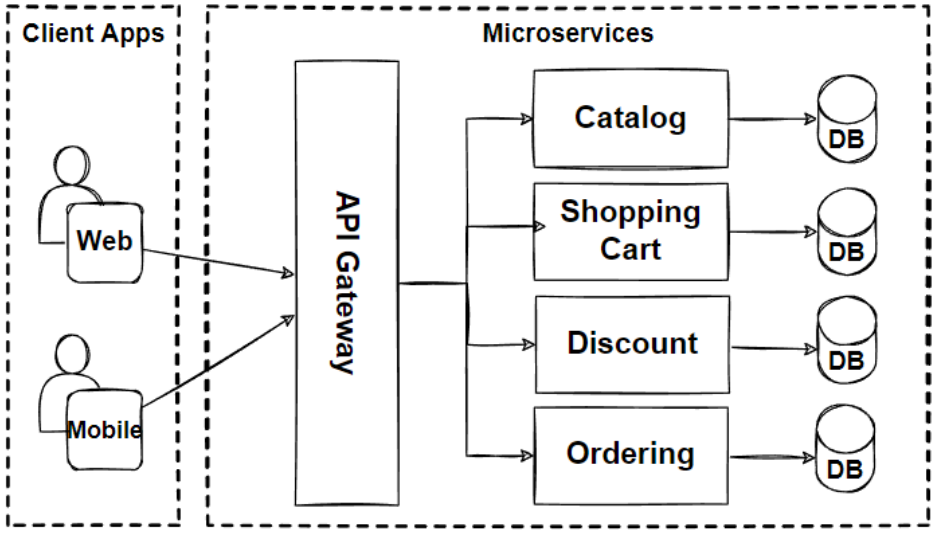
On the other hand, the microservices approach decentralizes the application by decomposing it into many services, each handling a specific domain area. Each service possesses its own code, data, and dependencies and can be scaled, deployed, and developed independently.
All About Microservices: Key Characteristics
- Independent deployability
- Loose coupling
- Business capability orientation
- Autonomous data management
- Lightweight communication (often REST/gRPC APIs or message queues)
- Decentralized governance & technology heterogeneity
- DevOps/CI/CD alignment
What Constitutes a Typical Microservices Framework?
- API Gateway – Single entry point for clients
- Service discovery – Dynamic locating of services
- Centralized configuration management
- Observability stack – Metrics, Logs, and Tracing (see observability solutions)
- Resilience patterns – Circuit breaker, bulkhead, retries
Understanding the Advantages & Challenges of Microservices
Like anything, microservices come associated with their plethora of benefits including:
- Independent development and deployment speed
- Scalability and performance tuning
- Resilience and fault isolation
- Technology flexibility
- Better alignment with DDD
- Organizational alignment via Conway’s Law
However, it’s not without its fair share of complexities primarily because of:
- Distributed system complexity
- Data consistency and transactions
- Testing complexity
- Operational overhead & tooling
- Observability and debugging (learn more about operational excellence in distributed systems)
- Over-fragmentation & service sprawl
How Do Microservices Fit Into your Operation?
Microservices architecture is typically an excellent fit for large and complex systems that have distinct business domains. However, for small and simple applications or smaller teams, a well-structured monolith could prove to be simpler and cheaper.
Consider microservices when you need independent scaling, modular release cycles, and organizational boundaries aligning with distinct business functions.
Relationship with Other Architectural Styles
Microservices can be traced back as an evolution of SOA (Service-Oriented Architecture). However, microservices are smaller, more fine-grained, and focus greatly on independent deployment and DevOps. They can coexist or be implemented alongside serverless functions but generally differ in that microservices are long-lived, stateful with APIs, whereas FaaS is event-driven and ephemeral.
For example, effective observability and operational monitoring are critical in both microservices and cloud-native AI-driven agent platforms. If you want to deepen the understanding of observability challenges and operational excellence in modern distributed systems, you might find valuable insights in our post about the AWS DevOps Agent, an AI-powered autonomous engineer designed to enhance operational governance and reliability.
Conclusion
So there you have it, our deep dive into the world of Microservices architecture. If you’re working with complex software with distinctive domains and have a robust CI/CD in place, moving to microservices could streamline your operation and inspire further innovation. However, each project comes with its unique set of necessities, and it’s crucial to analyze the benefits against your specific needs before making the switch.
In our upcoming blog posts, we might map out a migration plan from a monolith to microservices, give you a detailed walkthrough on designing a sample microservices system, or maybe even a head-to-head comparison of implementing microservices on popular cloud platforms like AWS, Azure, and Google Cloud. Stay tuned for more!
For a comprehensive comparison and practical guidance on building microservices systems on AWS, Azure, and Google Cloud, keep an eye out for our future detailed walkthroughs similar in scope and style to the insights shared in:
AWS DevOps Agent
Additionally, the concept of microservices is closely related to DevOps and continuous deployment practices. To understand how autonomous AI agents and modern tooling are transforming operational excellence in distributed systems, you can also explore:
Gemini Enterprise Agent Platform
Frequently Asked Questions
-
What are microservices in simple terms?
Microservices are small, independent applications that together make up a larger system. Each one focuses on a specific task and can be built, deployed, or updated separately.
-
Why choose microservices over a monolith?
Microservices let you work on, scale, and deploy parts of a system independently, which accelerates development and allows for greater flexibility—especially for large, complex apps.
-
What is the main trade-off when adopting microservices?
You gain speed and independence, but must embrace operational and architectural complexity—monitoring, orchestration, and troubleshooting require new approaches and tooling.
-
Do microservices work well on public cloud platforms?
Absolutely. Platforms like AWS, Azure, and Google Cloud offer services and guidance to accelerate building and managing microservices systems.
-
Where can I learn more about microservices, observability, and cloud-native operations?
Explore Microservices.io, the AWS DevOps Agent blog, and Gemini Enterprise Agent Platform for real-world insights on distributed architecture and operational excellence.
}